How to Ask Better Questions About Your Dog’s Food
These days, everyone is trying a little harder to be a good parent. Kids, pets, it doesn’t really matter. People have learned, partly from experience and partly from the internet, that the best-selling product on the shelf is not always the best one.
So parents Google things. Constantly.
“Can I give this to my six-month-old?”
“Is this ingredient safe for babies?”
“Baby product ingredient list explained.”
And if those same parents also have a dog, the search history eventually drifts there, too.
“Is my dog’s food safe?”
That question usually leads down a strange rabbit hole. Brand websites presenting marketing as education. Forum threads where no one agrees with anyone. The occasional study that raises important concerns but leaves you wondering what you’re actually supposed to do with the information.
After a while, many pet parents end up doing the same thing. They pick a bag that looks responsible enough and hope it’s fine.
You don’t need a science degree to ask those. You just need to know what matters.
That’s what this article is about. Five questions worth asking about your dog’s food, and what honest answers to those questions tend to sound like.
The 5 Questions Worth Asking
1. Has Your Product Been Tested For Heavy Metals And Industrial Contaminants, And By Whom?
This is the most important question, and the answer tells you a lot quickly. A brand that tests for contaminants will say so clearly and, ideally, point you to the results. What you’re listening for is whether the testing was done internally, meaning the brand ran its own tests in its own facility, or externally, meaning an independent laboratory with no stake in the outcome handled it.
Internal testing isn’t meaningless, but it has an obvious limitation. A company testing its own product for safety issues has an inherent conflict of interest, whether or not anyone acts on it. Independent labs don’t.
Organizations like the Clean Label Project use ISO 17025-accredited laboratories, which means their methodology has been externally verified for accuracy and consistency. That’s the kind of testing that carries weight.
If a brand can’t tell you who tested their product for contaminants, or deflects to AAFCO compliance as the answer, that’s a meaningful signal. AAFCO compliance covers nutritional adequacy. It says nothing about what else is in the bag.
2. Where Do Your Protein Sources Come From, And Are They Whole Ingredients Or Rendered Meal?
Protein is the first thing most pet parents look for on an ingredient list, and “chicken” or “beef” at the top of a label looks reassuring. What the label often doesn’t clarify is whether that protein is whole meat or rendered meal, and the difference matters more than most people realize.
Rendered meal, labeled as “chicken meal,” “meat by-product meal,” or similar, is made by cooking down organs, bones, and tissue left after human-grade cuts are removed.
Organs like the liver and kidneys accumulate heavy metals over an animal’s lifetime because those are the organs responsible for filtering toxins. When rendered into meal and concentrated into a dry kibble formula, those metals concentrate further.
The Clean Label Project’s 2025 study found that dry dog foods, which rely heavily on rendered by-product meals, averaged 180 ppb of lead and 184 ppb of arsenic. Fresh and minimally processed foods using whole, recognizable ingredients averaged 8.5 ppb and 13.9 ppb, respectively. The ingredient sourcing is a big part of why that gap exists.
A brand comfortable answering this question will know its suppliers, be able to describe their protein sources specifically, and understand why it matters.
3. Where Are Your Ingredients Sourced, And How Many Hands Do They Pass Through Before They Reach Your Facility?
Supply chain complexity is one of the hardest things to get a straight answer on, and it’s one of the more important ones. Ingredients in commercial pet food can pass through multiple distributors and middlemen before reaching a manufacturer, and each step adds distance between the brand and what’s actually in their product.
Local sourcing reduces that complexity. It shortens the chain, increases traceability, and makes it more feasible for a brand to actually know its suppliers rather than just having a contract with one.
According to reporting from Pet Food Industry, traceability and supply chain oversight are among the most significant variables in contamination outcomes, particularly for vitamin and mineral premixes, which are common sources of trace metal contamination.
Ask the brand where its main ingredients come from. If the answer is vague or generic, that’s worth noting.
4. Do You Publish Your Test Results, Or Are They Available On Request?
Transparency isn’t just about testing. It’s about what a brand does with the results. Some brands test proactively and publish their findings. Others test and keep the results internal. Others test only when required to respond to a complaint or recall. These are meaningfully different positions, and a brand’s answer to this question reveals which category they’re in.
Publishing results voluntarily means a brand is comfortable being accountable to the data, regardless of what it shows. That’s a different posture from making results available only when asked, which is still better than nothing, but suggests accountability is reactive rather than built in.
Consumer Reports, which tested 28 dog food brands in 2024, noted clearly that companies should be able to offer transparency about testing online or through direct contact. Their assessment was simple: if you can’t get a clear answer, you have other options.
5. Is Your Formula Appropriate For My Dog’s Life Stage, And Has That Been Verified Through Feeding Trials Or Nutrient Analysis?
This question is less about contamination and more about nutritional honesty, and it’s one that gets skipped more than it should. AAFCO allows brands to meet nutritional standards either through feeding trials, where real dogs eat the food and their health outcomes are tracked, or through nutrient analysis, where the formula is calculated against AAFCO’s nutrient profiles on paper.
Feeding trials are slower and more expensive. Nutrient analysis is faster and cheaper. Both can result in the same “complete and balanced” label. For most dogs eating a standard adult formula, the difference is manageable.
For puppies, seniors, pregnant or nursing dogs, and breeds with specific sensitivities, it matters more. A brand worth trusting should be able to tell you which method they use and why.
What “Tested” Actually Means
The word “tested” on a brand’s website or packaging can mean almost anything. It can mean the formula was run through AAFCO nutrient analysis before launch. It can mean bacterial contamination was checked at the manufacturing facility. It can mean a full panel of industrial and environmental chemicals was assessed by an independent, accredited laboratory. These are very different things, and brands sometimes use the word loosely.
When evaluating whether testing is meaningful, a few specifics help narrow it down. Was it done by an accredited independent lab? What did they test for, specifically? Nutritional content, pathogens, heavy metals, phthalates, pesticides, acrylamide, and PFAS are all different panels requiring different methods.
Was it done on the finished product, meaning the actual food in the bag, or on individual ingredients before processing? And critically, how recently was it done? A single test from four years ago on a formula that has since changed sourcing tells you very little.
Third-party certification from an organization like the Clean Label Project means a product has been independently purchased off a shelf, tested in an accredited laboratory, and assessed against contamination benchmarks.
It’s not a guarantee of perfection, but it’s a meaningful signal that the brand has been willing to submit to scrutiny rather than avoid it.
The Questions We Asked Ourselves
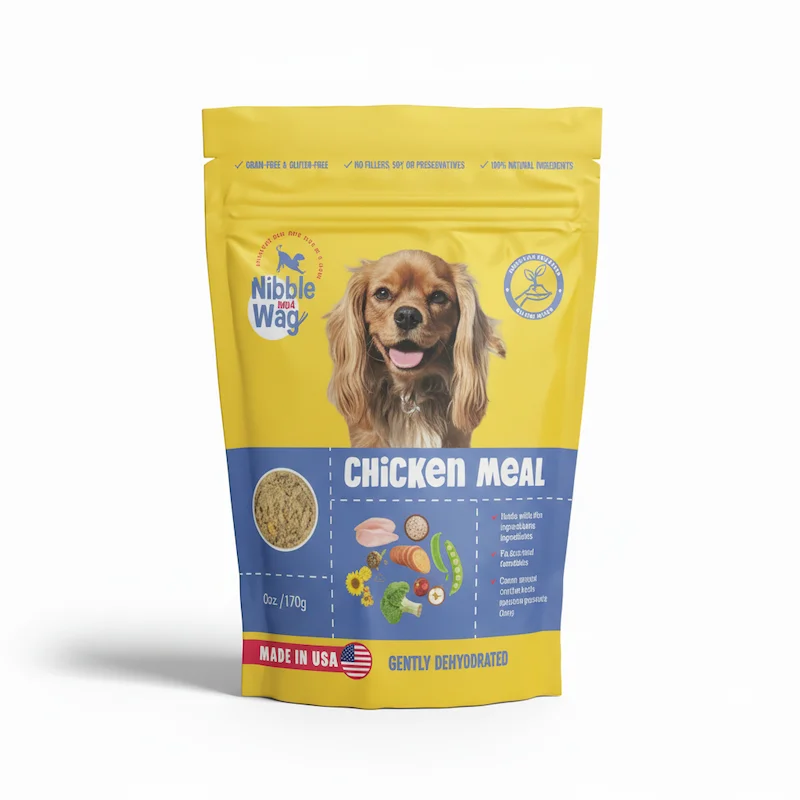
These are the questions we kept coming back to while building Nibble and Wag. Not as a checklist, but as a real standard we held ourselves to, because we couldn’t ask pet parents to trust our food if we hadn’t been willing to ask hard questions of our own sourcing, our own ingredients, our own supply chain.
Our ingredients are real and recognizable, locally sourced where possible, which shortens the chain between farm and bowl and makes traceability something we can actually stand behind. Our formulas are balanced for all life stages, because a standard that works only for some dogs isn’t a standard we’re comfortable with.
We care about what this costs for pet parents, because good nutrition shouldn’t require a premium price tag that puts it out of reach for most families.
And we care about where our ingredients come from beyond just what they are, because locally sourced food supports the farms and communities that grow it and reduces the supply chain complexity that creates contamination risk.
None of that earns trust on its own. Trust comes from being willing to answer the questions above directly, with specifics, every time.
Asking Is Enough to Start
You don’t need to be a nutritionist or a food scientist to make better decisions about your dog’s food. You need a few specific questions and the willingness to notice what kind of answer you get back.
Brands that have done the work will welcome those questions. They’ll have answers ready, and those answers will be specific. Brands that haven’t done the work will deflect, generalize, or point to compliance as a proxy for safety.
The difference between those two responses is worth paying attention to. Your dog eats the same food every single day. The least that food deserves is a brand willing to answer for what’s in it.